Table of Contents
ToggleTaking good care of yourself after an abortion matters a lot because it helps your body recover faster, lower risks of getting infections and also supports your physical and emotional well being.
If you are in South Africa, you have the right to safe, legal abortion services in 2026 and following recommended post-abortion care instructions provided by your healthcare provider is very important.
What Is Post-Abortion Care
According to the Abortion Care Handbook, post-abortion care refers to the medical care, advice, and support a person gets after an abortion to recover safely and stay healthy.
Why Is Post-abortion Care Important?
Post-abortion care is more than just ordinary advice. It really helps your body recover. And here’s why:
1 - Saves Lives
Complications like heavy bleeding and infections are a leading cause of maternal deaths. According to (WHO 2023), proper post-abortion care can reduce serious complications by up to 60%
2 - Fulfilling Human Rights
Under the International Human Rights Law, countries must provide post-abortion care in all situations, even where abortion is restricted or illegal. The care must be confidential, without discrimination, and without fear of criminal punishment.
3 - Preventing Unplanned Pregnancy
When family planning is started right away after ending a pregnancy, it reduces the risk of future unintended pregnancies and repeat abortions.
What Happens Physically Right After the Abortion
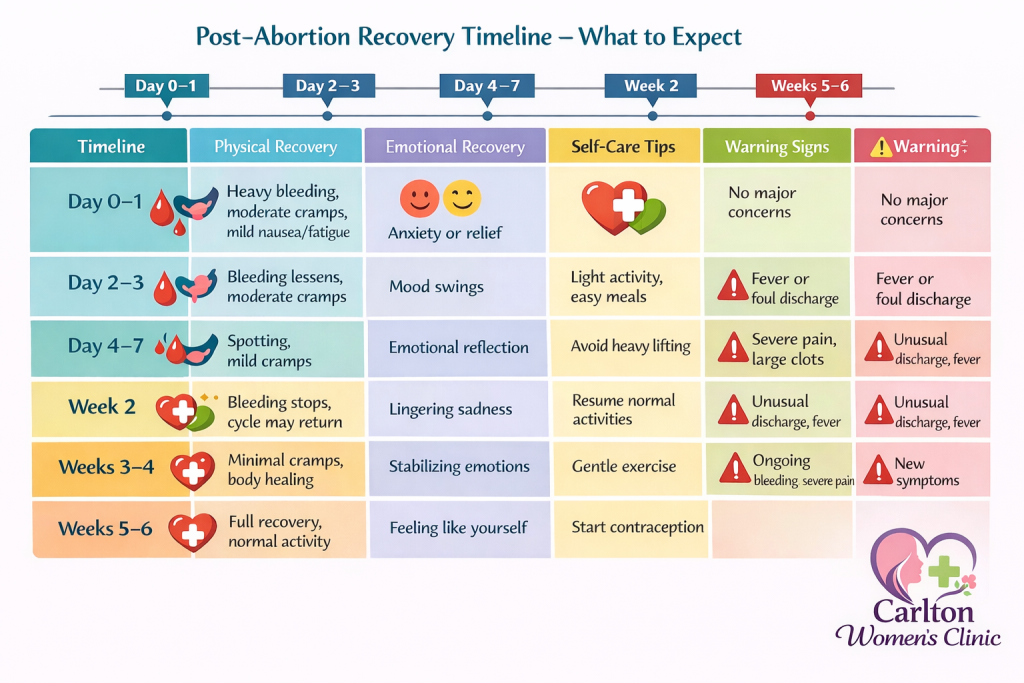
If you had a medical abortion, understanding what to expect during recovery is essential. For detailed guidance on the procedure and how it works, read our guide on What is A Medical Abortion ↗
Self Care Tips after Abortion
After an abortion, your body and mind need proper care, physically and emotionally, and following these self-care tips after abortion can help you recover in the shortest time.
Physical Self-Care
- Managing Pain: Use abdominal pain medication like nurofens for period pains but avoid Aspirin. (It will make you bleed more)
- Hygiene: Use ordinary heavy-flow menstrual pads to monitor bleeding. Do not use tampons in order to reduce the risk of infections.
- Resting: Give yourself a day or two of rest immediately following the procedure. Avoid strenuous activities like lifting or exercising.
Resuming Activities & Exercise
- Daily activities: You can usually go back to light activities the next day if you feel okay. Listen to your body and rest when needed.
- Exercise and heavy work: SafeAbortion.co.za guidelines state that after an abortion you should avoid heavy tasks like exercise, heavy lifting, or walking long distances for a few days.
- Swimming and baths: Stay out of swimming pools, hot tubs, and baths for 1–2 weeks to lower the risk of infection. Showering is safe right away.
- Sex: Wait until heavy bleeding has stopped, or about 1–2 weeks, before having penetrative sex. Ovulation after abortion can happen within one week after the procedure.
Emotional Self-Care
- Acknowledge Your Feelings: It is normal to experience a range of emotions, including relief, sadness, or mood swings caused by sudden hormonal shifts.
-
Seek Support:
Talk to trusted friends or family. If you need confidential, non-judgmental support, contact organizations such as:
- Carlton Women's Clinic : +27 83 765 1800
- Cavewell Medical Prac. : +27 78 575 4968
- SADAG: 0800 567 567
- Be Kind to Yourself: Activities such as keeping a journal, watching something you like, or going outside can help you cope.
Warning Signs & When to Seek Help!
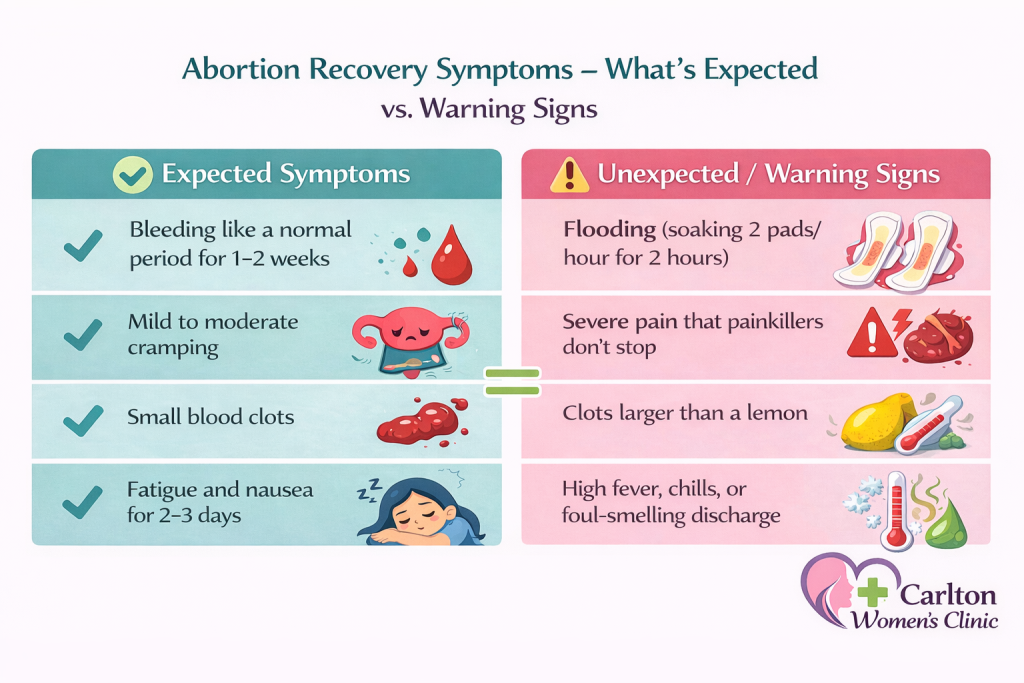
Abortion, whether self-managed or done at the doctor's office, is considered safe, and most people recover within a few days. While complications are rare, it is important to watch out for these warning signs:
- Excessive Bleeding: Soaking more than two maxi sanitary pads in one hour.
- Severe Constant Pain: Intense abdominal pain that does not improve even after taking pain medication.
- High Fever: A temperature of 38°C (100.4°F) or higher, especially if it lasts longer than 24 hours.
- Fainting or Dizziness: Feeling extremely lightheaded, fainting, or experiencing a rapid heartbeat.
- Continued Pregnancy Symptoms: Nausea, vomiting that continues for more than two weeks after the procedure.
Normal vs. Abnormal Symptoms
When to Start Birth Control After an Abortion
It is advisable to start contraception as soon as possible. Studies show that ovulation can return as early as 2 weeks after abortion, putting women at risk of a new pregnancy.
Long-term Contraception
- Implant (e.g., Implanon): Inserted under the skin of the upper arm and very effective when started within 5 days after an abortion.
-
Intrauterine Devices (IUDs):
Can be inserted immediately after a surgical abortion.
- After a medical abortion, IUD insertion may be delayed until the abortion is confirmed as complete.
- 📌 For a step-by-step guide on safe usage, see A Guide To Safe Abortion Pills ↗ .
Short-term Options
- Combined Pill, Patch, or Ring: These can be used the following day after the procedure.
- Progestogen-Only Pill: This can be use after 48 hours.
- Barrier Methods: Condoms (male & female) used whenever you feel ready to resume sexual intercourse.
Summary
Post-abortion care is an essential part of recovery for anyone who has had an abortion. Everyone’s abortion recovery will look a bit different and every body heals at its own pace.
Having someone to lean on to lean on can be helpful, as strong emotions after an abortion are normal, even when you’re confident in your decision.
Need support or a follow-up? WhatsApp our clinic today for confidential post-abortion care and guidance.
 Dr. Nelisiwe Mbele, with the
Carlton Women’s Clinic
Team
Dr. Nelisiwe Mbele, with the
Carlton Women’s Clinic
Team
Share with friends!
Frequently Asked
Post-Abortion Care Questions!
What can i use for pain relief?
You can take pain medicine like paracetamol or ibuprofen to help with cramps and abdominal pain.
Is it normal to feel emotional?
Yes, it’s completely normal. You might feel sad, relieved, or emotional for a few days or weeks after terminating a pregnancy. Talking to someone you trust can help.
Can I use tampons or normal pads?
Use pads, not tampons, for at least a week after abortion. Tampons can increase the risk of infection during recovery.
When will my next period return?
Your next period is likely to come back in 4–6 weeks, but it can be sooner or later for some people.
When can I resume normal activities?
Most people can go back to school, work, or perform light activities the next day, but avoid heavy exercise for a few days if you feel sore.
When is it safe to have sex?
.Wait until the bleeding stops and you feel ready, usually after 1–2 weeks. Using a condom is important to prevent infection or falling pregnant again.
- Healthline. (n.d.). Nutrition Tips After Abortion. Retrieved from https://www.132healthwise.com/food-you-should-eat-after-an-abortion.php
- BSW Health. (n.d.). Dietary Changes After Abortion. Retrieved from https://www.webmd.com/women/guide/abortion-recovery
- Healthline. (n.d.). Weight Loss After Abortion. Retrieved from https://www.healthline.com/nutrition
- Carlton Women’s Clinic Johannesburg. (n.d.). Right Abortion Method. Retrieved from https://www.womensclinicjohannesburg.co.za/best-abortion-method/
- HealthDirect. (n.d.). Oestrogen. Retrieved from https://www.healthdirect.gov.au/oestrogen
- WebMD. (n.d.). Progesterone Uses and Risks. Retrieved from https://www.webmd.com/vitamins-and-supplements/progesterone-uses-and-risks
- Carlton Women’s Clinic Johannesburg. (n.d.). Medication Abortion. Retrieved from https://www.womensclinicjohannesburg.co.za/medical-abortion-in-johannesburg/
- Carlton Women’s Clinic Johannesburg. (n.d.). Surgical Abortion. Retrieved from https://www.womensclinicjohannesburg.co.za/what-you-need-to-know-about-surgical-abortions/
- Cleveland Clinic. (n.d.). Foods to Help Healing. Retrieved from https://health.clevelandclinic.org/foods-to-help-healing
- Life Healthcare. (2023). Post-Surgical Diet Guidance. Retrieved from https://www.lifehealthcare.co.za/media/3773/life-oncology_diet-sheets_diarrhoea_june2023_v4-outlines.pdf
- PMC. (2014). Iron Deficiency and Wound Healing. Retrieved from https://pmc.ncbi.nlm.nih.gov/articles/PMC4091310/
- Food & Home Magazine. (n.d.). Anti-inflammatory Foods. Retrieved from https://www.foodandhome.co.za/how-to/anti-inflammatory-foods
- Carlton Women’s Clinic Johannesburg. (n.d.). Recovering from Abortion. Retrieved from https://www.womensclinicjohannesburg.co.za/recovering-from-abortion/
- Harvard Health Publishing. (n.d.). Proper Hydration. Retrieved from https://www.health.harvard.edu/staying-healthy/how-much-water-should-you-drink
- Carlton Women’s Clinic Johannesburg. (n.d.). Abortion Recovery Tips. Retrieved from https://www.womensclinicjohannesburg.co.za/abortion-recovery-tips/#post-abortion-care
- BSW Health. (n.d.). Consult Your Doctor Before Starting New Diet. Retrieved from https://www.bswhealth.com/blog/consult-your-doctor-before-starting-new-diet-or-fitness-program
The physical and hormonal healing period following an abortion, during which the body restores strength, balance, and normal function.
A condition caused by low iron levels, often linked to blood loss, leading to fatigue, weakness, and reduced oxygen transport.
The stabilization of reproductive hormones after pregnancy ends, supporting energy levels, mood, and overall recovery.
A key female hormone that regulates the menstrual cycle and reproductive system, which fluctuates after abortion.
A hormone that supports pregnancy and drops after abortion, triggering physical recovery processes.
The body’s ability to digest and absorb vitamins and minerals needed for healing and energy restoration.
Foods that help reduce inflammation in the body, supporting tissue repair and faster recovery.
A diet rich in protein that supports muscle repair, tissue healing, and immune strength.
The maintenance of essential minerals that regulate hydration, nerve function, and muscle activity.
A measure of how well the body is supplied with fluids, essential for circulation and healing.
The process by which the body rebuilds damaged or stressed tissues following a medical procedure.
Dietary choices that strengthen the immune system and help protect against infection during recovery.
Foods high in iron that help replenish blood levels and reduce post-procedure fatigue.
The process by which vitamin C enhances iron uptake and supports immune and tissue health.
Medical guidance, nutrition, and self-care practices that support safe and complete recovery.